Shields LabTowson University

The Shields Lab · Towson University

How insects taste and smell

We study the chemical senses insects use to find food and avoid harm, and we test plant-derived repellents against crop pests such as spotted-wing drosophila.

Electrophysiology Behavioral assays Chemical ecology

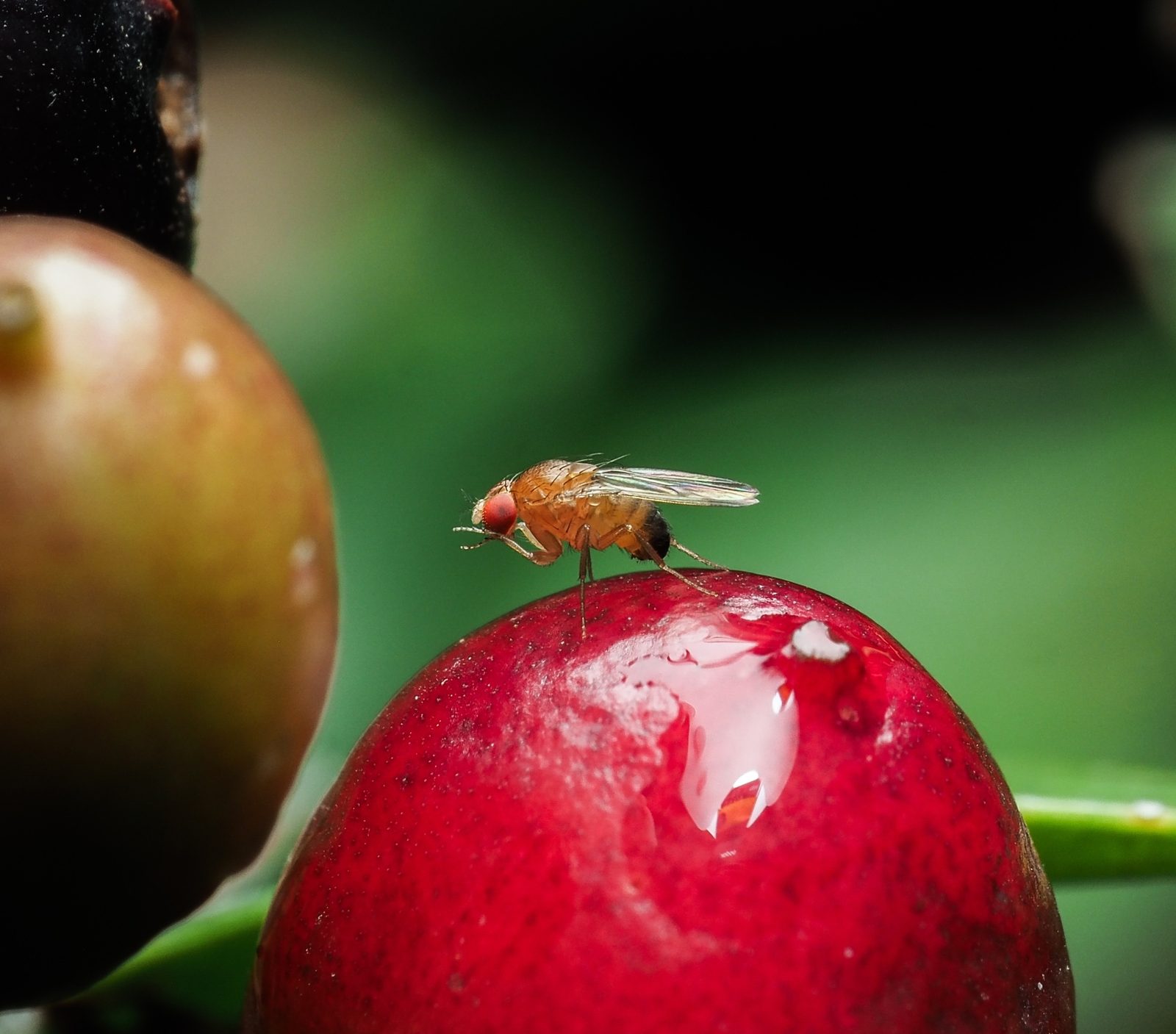
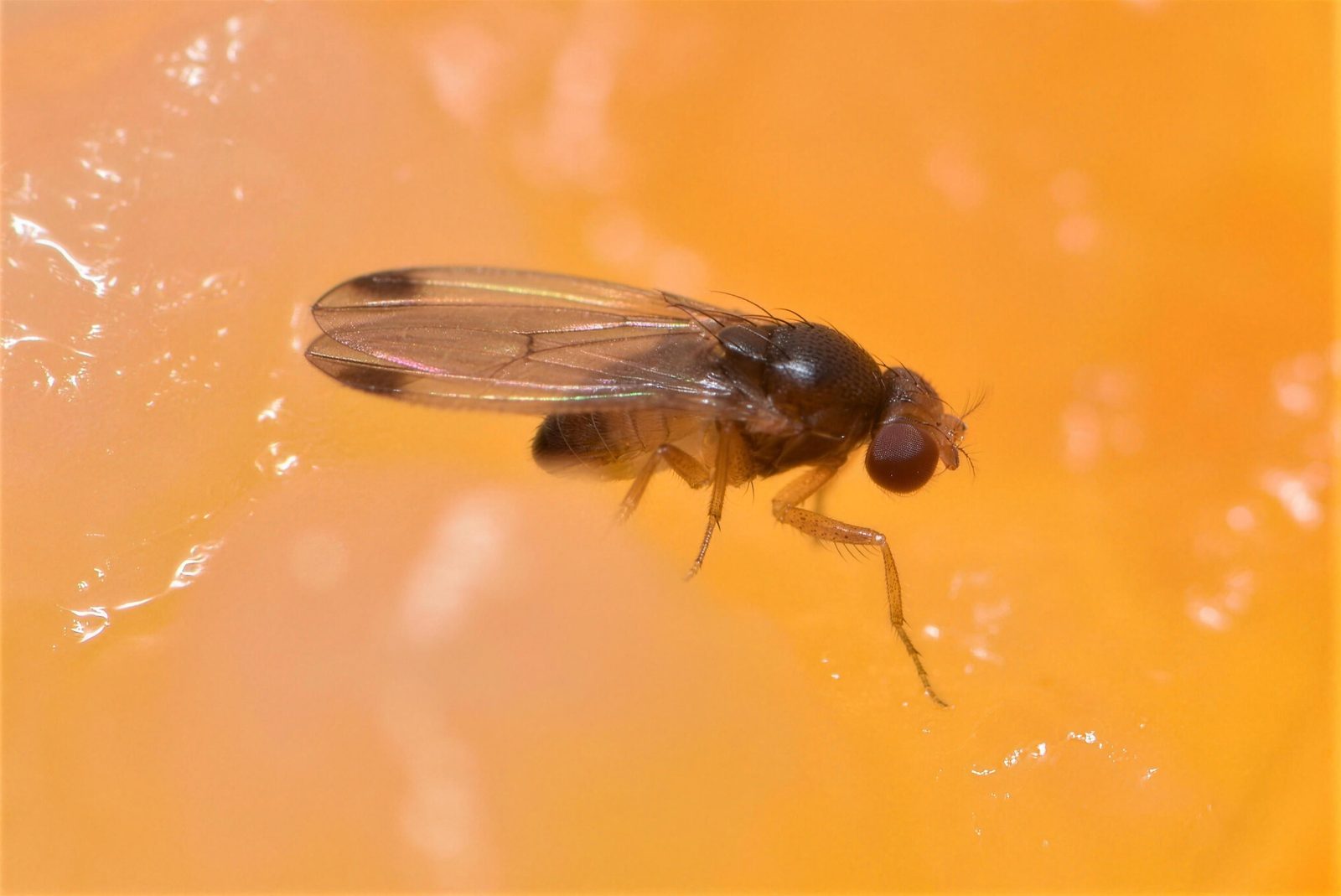
A male spotted-wing drosophila, with a dark spot near the tip of each wing, standing on the orange flesh of a fruit
Drosophila suzukii (Matsumura, 1931) Spotted-wing drosophila · Diptera: Drosophilidae. Photo: Braden J. Judson, CC0

Interactive model

The orchard

Fruit flies gather on a blueberry cluster. Release methyl benzoate, or its analog E4MOB, and watch how far the plume pushes them back. It is a teaching model of the push in a push-pull system, not lab data.

Simulation · fruit flies and methyl benzoateMove the cursor to release methyl benzoate, then hold still to watch the flies through the ×3 lens. Click to hang a dispenser on the branch.Tap to hang a dispenser on the branch.

Flies on the fruit0 / 0

E4MOB is ethyl 4-methoxybenzoate, one of the methyl benzoate analogs the lab tests. Fly numbers and compound strengths are illustrative, not lab data.

The lab works on the senses insects use to choose food and avoid harm: taste cells on a caterpillar’s mouthparts, odor receptors on a moth’s antenna, and the avoidance a single plant volatile can set off in a fruit fly. Current projects screen analogs of methyl benzoate against spotted-wing drosophila, an invasive pest of soft fruit, and essential oils against the house cricket.

Current projects

Three insects, three questions

Each project pairs a behavior people care about, a crop pest avoiding a plant or a caterpillar refusing a leaf, with the sensory cells that drive it.

A spotted-wing drosophila standing on a ripe red berry
Drosophila suzukii (Matsumura, 1931) Spotted-wing drosophila · Diptera: Drosophilidae. Photo: Timotej Velkov, CC0

Program 1 · Drosophila suzukii

Can a small change make methyl benzoate a stronger repellent?

Methyl benzoate keeps spotted-wing drosophila away, but only at high doses, and flies vary in how they respond. We screen analogs that change the ester group, a ring substituent, or both. Several work at lower doses.

  • AssayTwo-choice spatial repellency, 24 female flies per tube
  • CompoundsMethyl benzoate and structural analogs
  • StatusPresented at NCUR 2026; paper in preparation
The analog screen
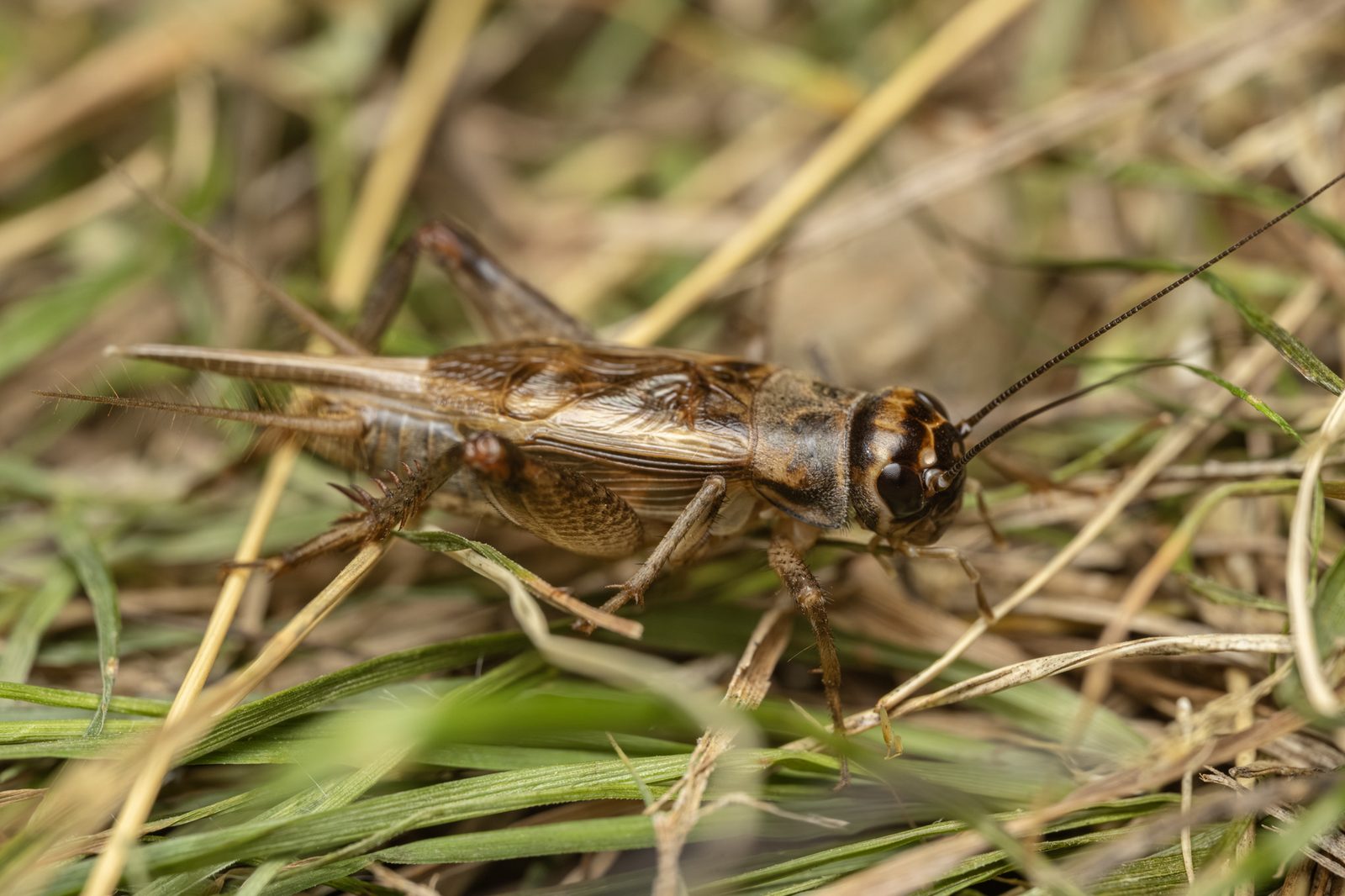
An adult house cricket standing in dry grass
Acheta domesticus (Linnaeus, 1758) House cricket · Orthoptera: Gryllidae. Photo: Manuel Raab, CC BY-NC 4.0

Program 2 · Acheta domesticus

Which essential oils do house crickets avoid?

We screened 27 essential oils on house crickets in an open arena with a treated bottle they could walk into, and counted how many went in.

  • Screened27 essential oils
  • Dose-testedPeppermint, rosemary, cinnamon and lemongrass
  • PaperInsects 17(1): 106, 2026
The cricket study
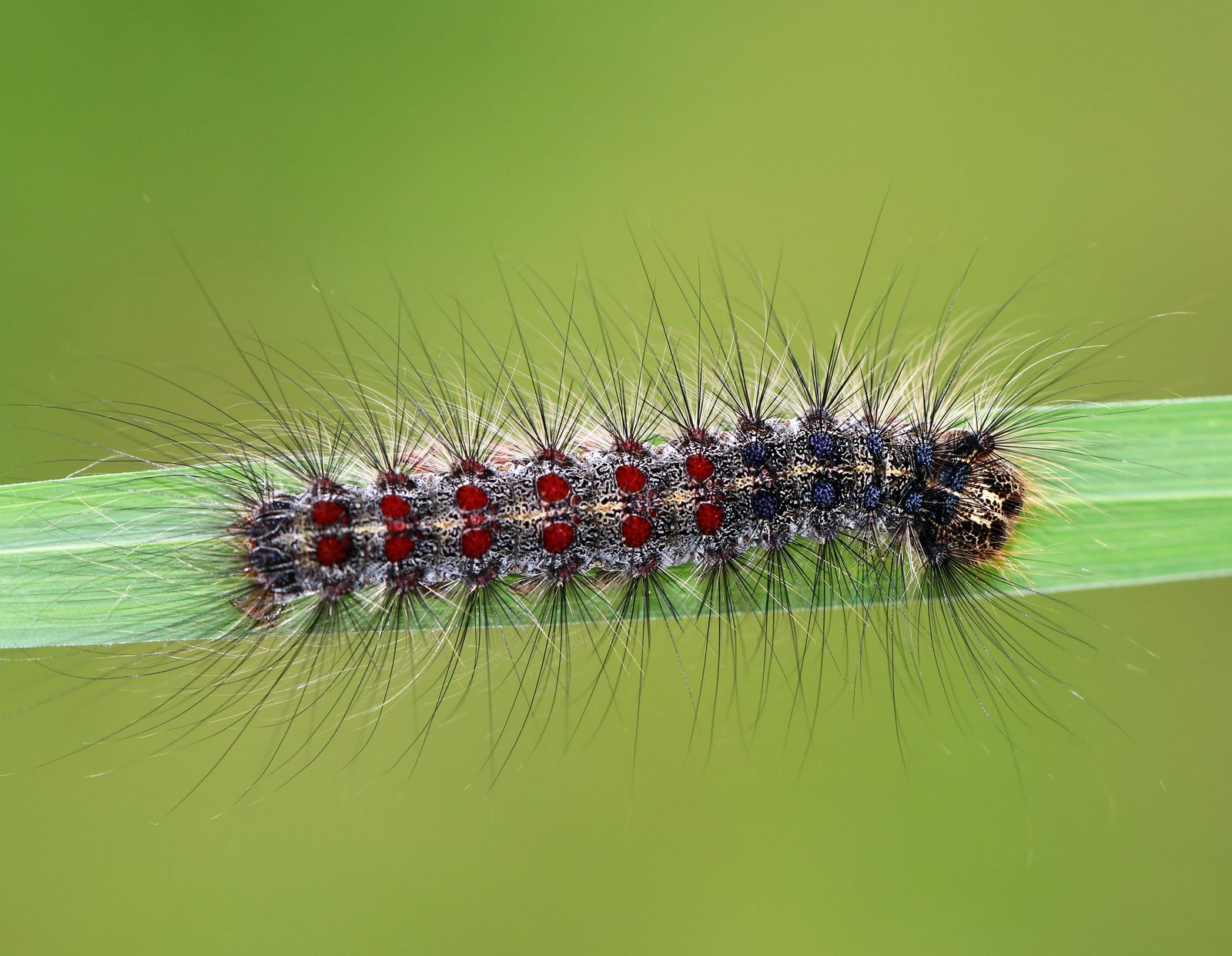
A spongy moth caterpillar on a blade of grass, with pairs of blue and red spots along its back
Lymantria dispar (Linnaeus, 1758) Spongy moth caterpillar · Lepidoptera: Erebidae. Photo: Christine Young, CC BY 4.0

Program 3 · Lymantria dispar

How does a caterpillar taste a repellent?

Tip recordings from spongy moth caterpillars found that a deterrent taste cell, already known to fire for caffeine and nicotine, also fires for DEET, IR3535 and picaridin.

  • MethodTip recordings from styloconic sensilla
  • FindingFirst report of repellents detected by caterpillar taste cells
  • PaperPLoS ONE 9(6): e99924, 2014
Taste receptor cells

The work in numbers

27

essential oils screened against the house cricket

Heinbockel et al. 2026, Insects 17: 106
102

plant volatiles tested on single moth olfactory sensilla

Shields and Hildebrand 2001
8

types of antennal sensilla described in Manduca sexta

Shields and Hildebrand 1999a, b
$718M

estimated yearly U.S. small-fruit losses to spotted-wing drosophila

Northeast SARE LNE22-455R

From molecule to field

How a repellent works

Five steps, each from the lab’s own papers and talks, show how a plant volatile could protect a crop. Scroll to move through them.

OOCH₃ benzene ringmethyl ester group Methyl benzoate C₈H₈O₂
Pores in the wallDendrites Cuticle of the antennaReceptor neurons Odor molecules
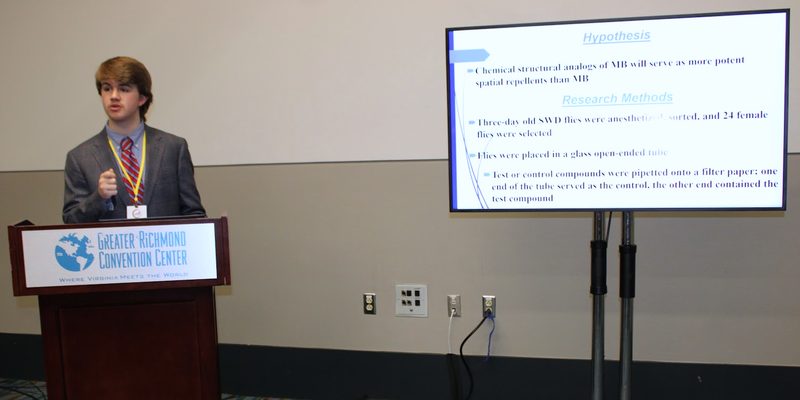
Torben Heinbockel speaks at the podium with one hand raised in a loose fist. The screen beside him reads Hypothesis: chemical structural analogs of MB will serve as more potent spatial repellents than MB. Under Research Methods it says that three-day-old SWD flies were anesthetized and sorted, 24 female flies were selected and placed in a glass open-ended tube, and test or control compounds were pipetted onto filter paper at the two ends.
Torben Heinbockel at NCUR 2026, beside the slide with the hypothesis and the two-choice tube method.
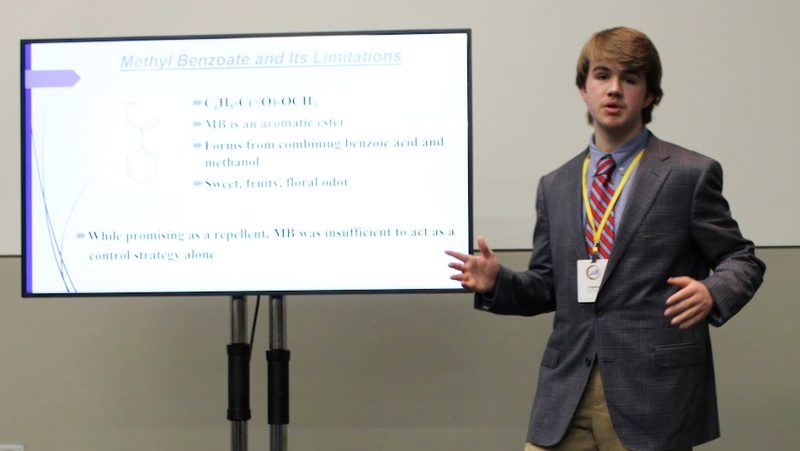
Torben Heinbockel stands to the right of a screen and speaks to the room with both hands open. The slide, Methyl Benzoate and Its Limitations, shows the ring structure of methyl benzoate, the formula C6H5-C(=O)-OCH3, notes that it is an aromatic ester with a sweet, fruity, floral odor, and says it was insufficient as a control strategy alone.
The NCUR 2026 slide on methyl benzoate: it was not enough as a control strategy on its own.

01

One molecule

Methyl benzoate is a small volatile that many plants make, and an FDA-approved food additive. Spotted-wing drosophila, an invasive pest of soft fruit, avoid it.

Gale et al. 2024, Insects 15: 47.

02

Into the pores

Insects smell with sensilla, hollow hairs on the antenna. Odor molecules pass through pores in the sensillum wall and reach the dendrites of receptor neurons inside. Dr. Shields’s electron microscopy described eight types of sensilla on the antenna of the female tobacco hornworm moth.

Shields and Hildebrand 1999a, b, Canadian Journal of Zoology. The drawing is not to scale.

03

Turned into spikes

A receptor neuron reports an odor as a train of action potentials. Recordings from one of those eight types, made while testing 102 plant volatiles, sorted these sensilla into three functional types.

Shields and Hildebrand 2001, J. Comp. Physiol. A 186: 1135–1151. The trace is an illustration, not a recording.

04

Counted in a tube

In the lab’s assay, 24 female flies are released along an open glass tube with the test compound at one end and solvent at the other, and the flies on each side are counted. The dose that repels half of them is the RD50. Several analogs of methyl benzoate repelled flies more strongly at lower doses.

Heinbockel and Shields, NCUR 2026.

05

Pushed out of the field

In a field trial in highbush blueberry with Rutgers University and the USDA, methyl benzoate dispensers reduced infestation when fly pressure was very high. They were tested as the “push” of a push-pull system, which pairs a repellent on the crop with lure traps that pull the pest away. The traps alone did not give comparable protection, and adding them did not improve on the dispensers’ effect.

Gale, Ferguson, Rodriguez-Saona, Shields and Zhang 2024, Insects 15: 47.
April 15, 2026 · Richmond, Virginia

NCUR 2026

Torben Heinbockel presented the methyl benzoate analog screen as a talk and the house cricket study as a poster at the National Conference on Undergraduate Research.

Talk: session 172, Environmental Science and Sustainability, presentation 908 · Poster 1203 · Greater Richmond Convention Center

The talk

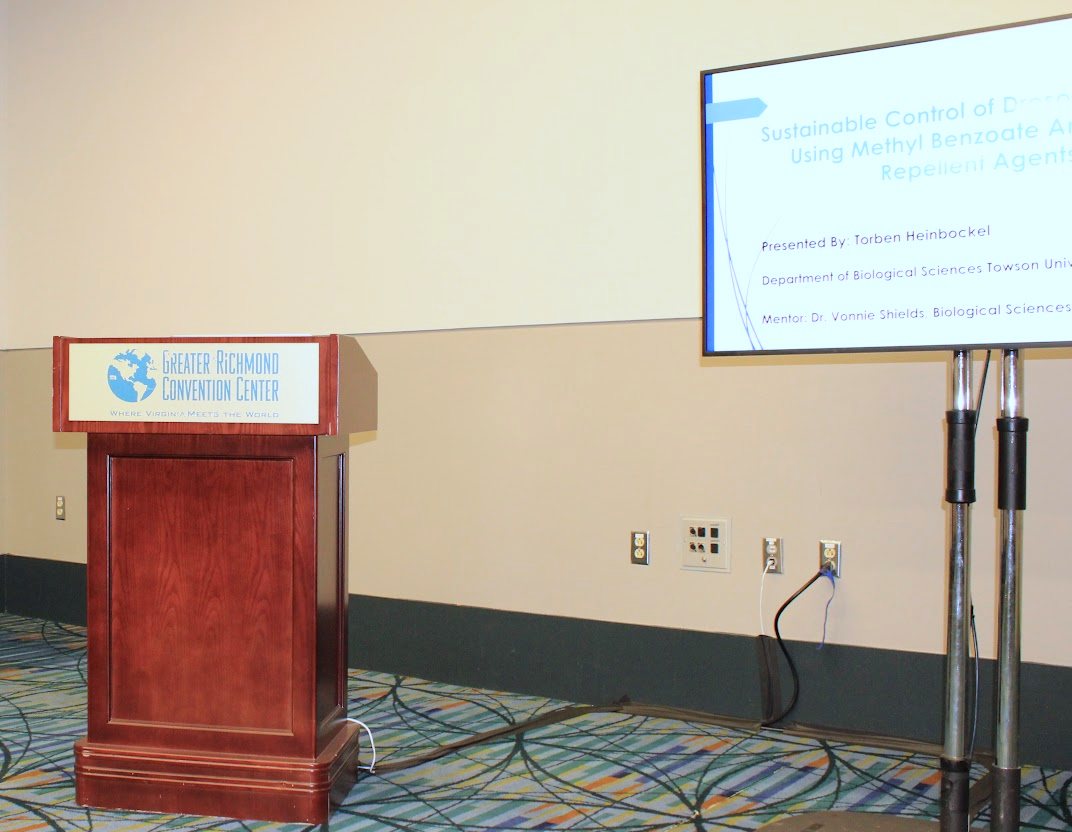
  • An empty wooden podium with a Greater Richmond Convention Center sign stands in a carpeted room. To its right is a screen, partly out of frame, showing the talk's title slide with the lines Presented By: Torben Heinbockel and Mentor: Dr. Vonnie Shields.
    The session room, with the title slide on screen.
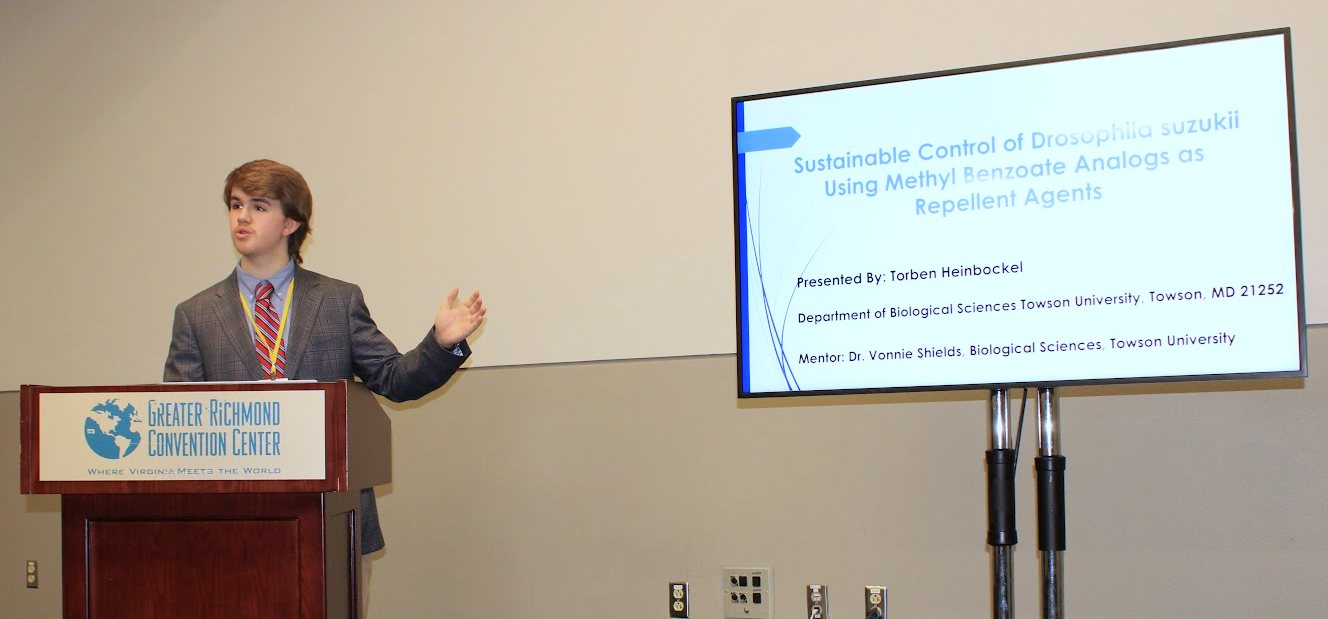
  • Torben Heinbockel speaks at the Greater Richmond Convention Center podium and gestures with an open hand toward a screen showing the title slide Sustainable Control of Drosophila suzukii Using Methyl Benzoate Analogs as Repellent Agents. The slide credits Torben Heinbockel, Department of Biological Sciences, Towson University, as presenter and Dr. Vonnie Shields as mentor.
    The title slide, with Dr. Vonnie Shields as mentor.
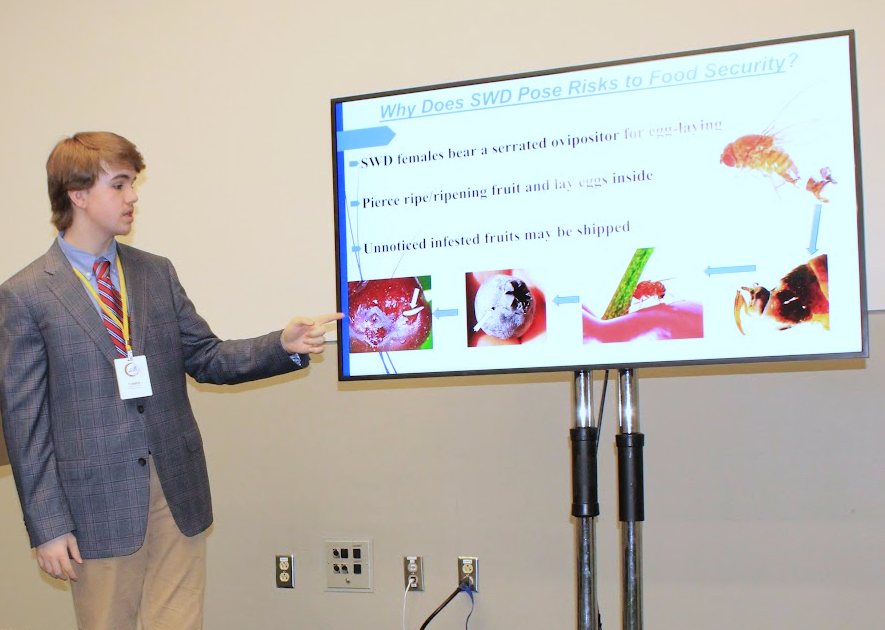
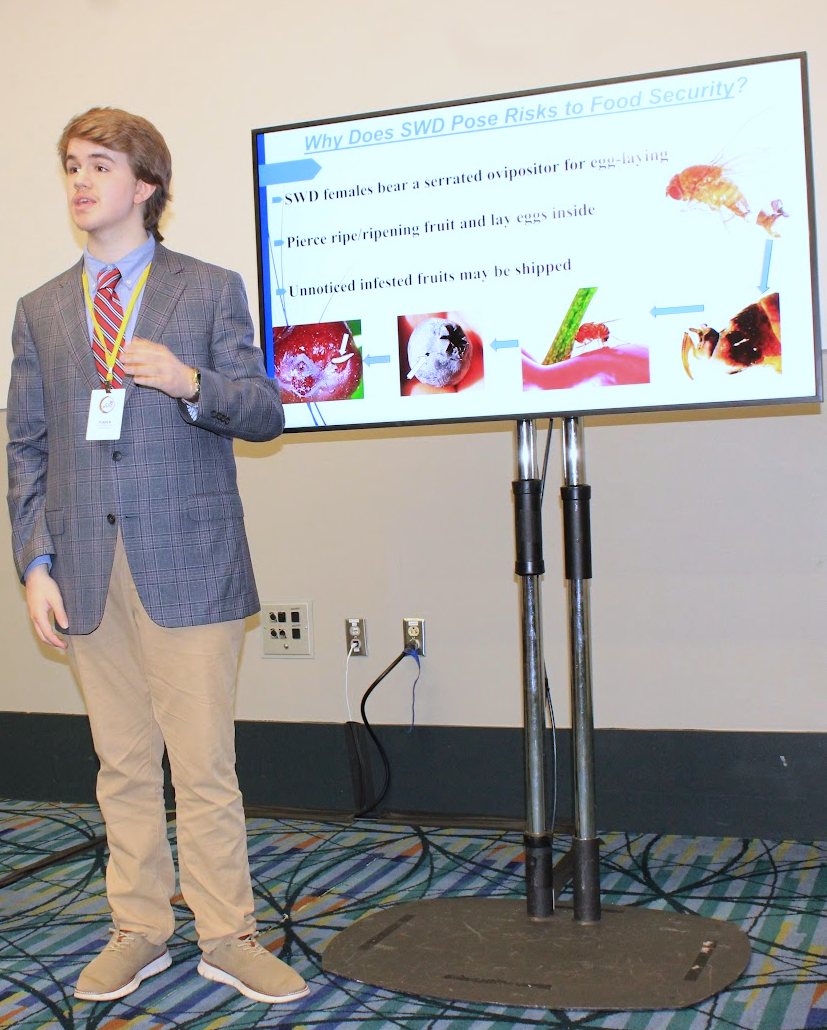
  • Torben Heinbockel, in three-quarter profile, points at a photo of damaged fruit on a slide titled Why Does SWD Pose Risks to Food Security?. The slide also shows a fly and a row of fruit-damage photos linked by arrows.
    Why the fly matters: females lay eggs inside ripening fruit.
  • A low-angle, full-length view of Torben Heinbockel speaking beside a screen showing the slide Why Does SWD Pose Risks to Food Security?, with one hand at his chest. The slide shows a fly and photos of damaged fruit.
    Talking through the food-security slide.
  • Also at NCUR 2026 · poster 1203

    Behavioral olfactory responses of crickets to essential oils

    The house cricket study, by Torben Heinbockel and Dr. Shields, in poster session 011.

All ten photos from NCUR 2026

2025 to 2026

News

  • November 2026
    Dr. Shields and Torben Heinbockel present “Sustainable control of Drosophila suzukii using methyl benzoate analogs as repellent agents” at the Society for Neuroscience meeting in Washington, DC, November 14–18. upcoming
  • November 2026
    Torben Heinbockel speaks on near-peer mentorship, “The mentor next door,” at the Sigma Xi International Forum on Research Excellence (IFoRE), held online November 6–7. upcoming
  • August 2026
    Two lab posters at the NIH BRAIN Initiative Conference in Rockville, Maryland: one on how volatile structure shapes avoidance in Drosophila suzukii, one on plant-derived volatiles and chemosensory avoidance in an insect model.
  • May 2026
    Torben Heinbockel and Dr. Shields published a review in Insects, “Essential oils as biofriendly alternatives to synthetic insect repellents.”
  • January 2026
    The lab’s house cricket study, “Selected essential oils act as repellents against the house cricket, Acheta domesticus,” was published in Insects.

All news, talks and awards

Short answers, with sources

Questions about the work

What does the Shields Lab study?

The Shields Lab at Towson University studies insect taste and smell: how insects detect plant compounds with sensory cells on their mouthparts and antennae, and how those signals steer feeding and avoidance. The lab also tests plant-derived repellents against insect pests, including spotted-wing drosophila and the house cricket.

What is spotted-wing drosophila?

Spotted-wing drosophila, Drosophila suzukii, is an invasive fruit fly. Unlike most fruit flies, the female has a serrated ovipositor that cuts into ripe and ripening berries to lay eggs, so infested fruit can look ready to pick. U.S. losses in small fruit are estimated at $718 million a year (Northeast SARE project LNE22-455R).

Why test methyl benzoate as an insect repellent?

Methyl benzoate is a volatile made by many plants and an FDA-approved food additive, and spotted-wing drosophila avoid it. In a highbush blueberry field trial, methyl benzoate dispensers reduced infestation when fly pressure was very high (Gale et al. 2024). It works only at high doses, so the lab screens structural analogs; several repelled flies more strongly at lower doses (Heinbockel and Shields, NCUR 2026).

Which essential oils repel house crickets?

In a screen of 27 essential oils, house crickets were strongly repelled by nearly half of them. Four strong repellents, peppermint, rosemary, cinnamon and lemongrass oils, were then tested at several doses and repelled more strongly at higher doses, while the synthetic repellents DEET and IR3535 had no significant effect (Heinbockel et al. 2026, Insects 17: 106).

How does a caterpillar taste a repellent?

Spongy moth caterpillars taste with styloconic sensilla on their mouthparts. Tip recordings had shown that a deterrent cell in the medial sensillum fires for caffeine and nicotine; the lab then found that the same cell also fires for DEET, IR3535 and picaridin, the first report of insect repellents detected by a caterpillar’s taste cells (Sanford et al. 2014, PLoS ONE).

How can a student join the Shields Lab?

Email Dr. Shields at vshields@towson.edu with your major and year, the projects that interest you, and how many hours a week you can give. Undergraduate, master’s and pre-college students have run projects in the lab and presented them at national meetings.

Run the next tube.

Students in the lab run their own projects, from rearing insects to presenting at national and regional meetings, including ABRCMS, NCUR, the Society for Neuroscience and SICB.

How to join